Introduction
The enterprise AI landscape has undergone a seismic shift. What began as simple chatbots answering FAQs has evolved into autonomous AI agents capable of planning, reasoning, executing multi-step tasks, and collaborating across entire business functions. In 2026, agentic AI is no longer a futuristic concept—it is an operational reality reshaping how organizations work, compete, and deliver value.
According to the World Economic Forum, the agentic AI market is poised to reach $45 billion by 2030, growing from approximately $8.5 billion in 2026. Gartner projects that 40% of enterprise applications will embed task-specific AI agents by the end of 2026, a dramatic leap from less than 5% just a year earlier. Meanwhile, a Protiviti AI Pulse Survey indicates that nearly 70% of organizations plan to integrate autonomous or semi-autonomous AI agents into their workflows this year.
But what exactly makes agentic AI different from the generative AI tools we have grown accustomed to? And how are leading organizations navigating the transition from experimentation to production-grade deployment?
What Is Agentic AI?
Agentic AI refers to AI systems that go beyond responding to prompts. These systems can autonomously perceive their environment, set goals, create plans, use tools, and execute complex workflows with minimal human intervention. Unlike traditional AI assistants that wait for instructions, agentic systems take initiative.
The key characteristics that define agentic AI include:
- Autonomy: The ability to operate independently, making decisions without requiring human approval for every action.
- Goal-Oriented Behaviour: Agents work toward defined objectives, breaking complex goals into manageable sub-tasks.
- Tool Use: Agents can interact with external systems, APIs, databases, and applications to accomplish their tasks.
- Memory and Context: Agents maintain state across interactions, learning from previous actions and adapting their approach.
- Reasoning and Planning: Agents can analyse situations, weigh options, and develop multi-step strategies.
This represents a fundamental evolution from the “prompt-in, response-out” paradigm of early generative AI. Agentic systems are workers, not just tools.
The Enterprise Adoption Landscape
The adoption curve for agentic AI in 2026 tells a nuanced story. McKinsey’s 2025 global survey found that 62% of organizations are experimenting with AI agents. However, Deloitte’s Emerging Technology Trends study reveals that only 14% have achieved production-ready solutions. This gap between experimentation and deployment highlights the challenges organizations face in moving from proof-of-concept to enterprise-scale implementation.
Despite these challenges, the momentum is undeniable. Salesforce describes the emergence of the “Agentic Enterprise”—organisations where humans and AI agents work together, with intelligence operating continuously across workflows. Microsoft, Google, IBM, and virtually every major technology provider has made agentic AI central to their 2026 product strategies.
Why Now?
Several converging factors have made 2026 the breakout year for enterprise agentic AI:
1. Model Maturity: Agentic models have become dramatically better at following plans, using tools reliably, and maintaining coherence across long task sequences.
2. Framework Evolution: Agent frameworks like LangGraph, CrewAI, and AutoGen have shipped production-grade orchestration capabilities, making it practical to build and deploy agent systems.
3. Infrastructure Readiness: Cloud providers now offer purpose-built infrastructure for agent deployment, monitoring, and governance.
4. Protocol Standardization: The emergence of standards like the Model Context Protocol (MCP) and Agent-to-Agent (A2A) protocol has created interoperability layers that make agent ecosystems viable.
5. Economic Pressure: Organizations facing labor shortages, cost pressures, and competitive threats are motivated to automate complex knowledge work.
Real-World Enterprise Applications
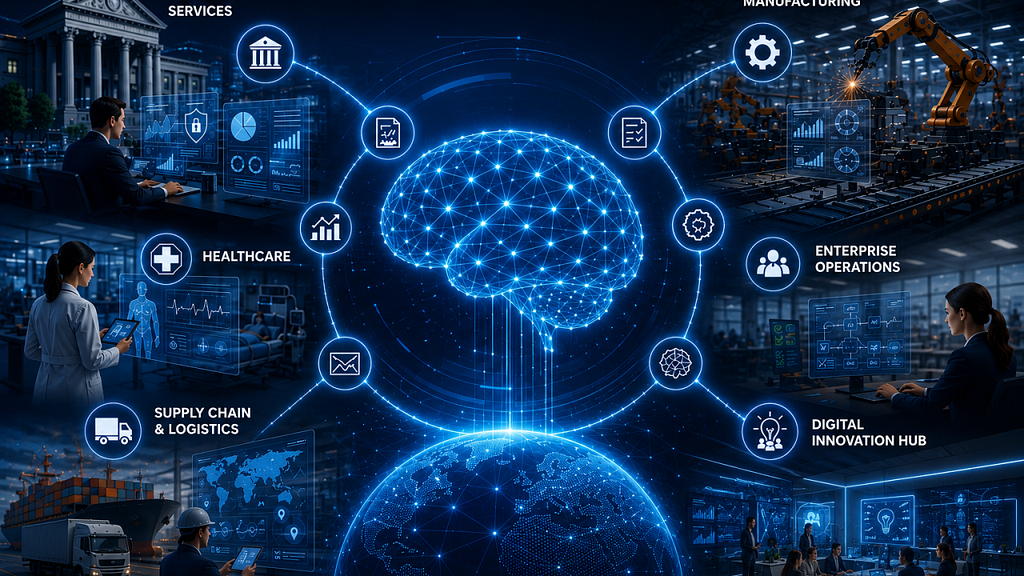
Financial Services
The global AI in banking market is projected to reach $45.6 billion in 2026. Banks are deploying agentic AI for fraud detection, compliance monitoring, customer onboarding, and loan processing. BCG reports that in the front office, AI agents are taking over routine tasks previously carried out manually, freeing staff for higher-value activities.
McKinsey predicts that within three to five years, an AI agent could become the channel of choice for all banking interactions, acting as the primary interface between customers and their financial institutions. Lloyds Banking Group has announced enterprise-wide deployment of agentic AI across its financial services operations in 2026.
Healthcare
Over 80% of healthcare executives expect agentic AI to deliver significant value across both clinical and back-office operations in 2026. Use cases span autonomous clinical documentation, AI-powered decision support, personalized treatment planning, remote patient monitoring, intelligent scheduling, and claims processing.
Agents can review medical necessity against coverage rules, adjudicate straightforward claims, route complex exceptions, and learn from outcomes to reduce future manual review. The technology is moving beyond automation to manage clinical complexity, streamline patient journeys, and expand access to specialty care.
Supply Chain and Logistics
In 2026, AI agents are moving beyond single-task optimization into fully autonomous workflows. They route shipments, vet carriers, generate invoices, clear customs documentation, and flag disruptions before they cascade through the supply chain. SAP emphasizes that AI delivers lasting value in supply chain management only when embedded where work actually happens—autonomous agents rely on deeply integrated processes and trusted data.
ISM World reports that AI-driven systems are now initiating transactions, triggering replenishment orders, selecting suppliers within predefined parameters, reserving inventory, and in some cases authorizing payment execution.
Manufacturing
LLMs and agentic systems are being applied for production optimisation, quality control, predictive maintenance, and autonomous robotics. From my experience, Agentic LLMs can dynamically analyse shopfloor information and select appropriate processing machines, providing dynamic functionality without the need for pre-training on specific manufacturing scenarios.
The Challenges Ahead
Despite the promise, the path to enterprise agentic AI is not without obstacles:
Reliability and Trust
Agents that operate autonomously must be reliable. A single erroneous decision—an incorrect financial transaction, a wrong medical recommendation, a miscalculated machine parameter or a misrouted shipment—can have serious consequences. Organisations need human-in-the-loop for robust testing, monitoring, and contingencies to prevent such scenarios.
Governance and Control
As agents gain more autonomy, questions of accountability become critical. Who is responsible when an agent makes a mistake? How do organizations maintain oversight without negating the efficiency gains of automation?
Security
IBM reports that 13% of companies experienced an AI-related security incident in 2025, with 97% of those affected acknowledging a lack of proper AI access controls. As agents gain access to sensitive systems and data, the attack surface expands significantly.
Integration Complexity
Enterprise environments are complex ecosystems of legacy systems, proprietary databases, and diverse applications. Integrating agents that can navigate this complexity reliably and coherently remains a significant engineering challenge.
Organisational Change
Perhaps the most underestimated challenge is the human one. Deploying agentic AI requires rethinking workflows, roles, and organizational structures. Deloitte notes that leading organisations are finding success by reimagining operations and managing agents as workers—a fundamental shift in how work is conceived and organized.
Best Practices for Enterprise Adoption
Based on the experiences of early adopters, several best practices have emerged:
1. Start with High-Value, Low-Risk Use Cases: Begin with tasks where the cost of errors is manageable and the value of automation is clear. Back-office operations, document processing, and internal knowledge management are common starting points.
2. Implement Human-in-the-Loop Patterns: Rather than full autonomy from day one, deploy agents with human oversight for critical decisions. Gradually expand autonomy as trust is established.
3. Invest in Observability: Build comprehensive monitoring and logging from the start. Understanding what agents are doing, why they are making specific decisions, and where they are failing is essential for improvement and compliance.
4. Establish Governance Frameworks: Define clear policies for agent behaviour, data access, decision authority, and escalation procedures before deployment.
5. Design for Collaboration: The most effective deployments treat agents as team members, not replacements. Design workflows where humans and agents complement each other’s strengths.
6. Plan for Scale: Architecture decisions made during pilot phases often become constraints at scale. Design agent infrastructure with enterprise-scale requirements in mind from the beginning.
The Road Ahead
Gartner’s projection that more than 40% of agentic AI projects will be cancelled by the end of 2027 serves as a sobering reminder that technology alone is not sufficient. Success requires thoughtful implementation, organisational readiness, and realistic expectations.
However, for organisations that navigate these challenges successfully, the rewards are substantial. The agentic enterprise represents a new operating model—one where routine cognitive work is handled by AI, humans focus on judgment, creativity, and relationship-building, and the boundary between what is possible and what is practical continues to expand.
The question for enterprise leaders in 2026 is no longer whether to adopt agentic AI, but how to do so responsibly, effectively, and at scale.
The Workforce Impact: New Roles and Skills
The rise of agentic AI is creating entirely new job categories while transforming existing ones:
Emerging Roles
- Agentic AI Engineer/Orchestrator: Directs AI coding agents to design, generate, review, and debug production software across frontend, backend, and data layers, taking ownership of system architecture, specifications, evaluations, and the reliability of AI-assisted development workflows.
- AI Agent Architect: Designs the overall agent system architecture, defining agent boundaries, communication patterns, and governance structures.
- Prompt Engineer / Context Engineer: Crafts the instructions, guardrails, and context that shape agent behaviour. This role is evolving from simple prompt writing to comprehensive context engineering.
- Agent Operations Manager: Monitors deployed agents, manages their performance, handles escalations, and continuously improves agent behaviour based on operational data.
- Human-AI Workflow Designer: Designs the collaboration patterns between human workers and AI agents, ensuring smooth handoffs and appropriate oversight.
- AI Compliance Specialist: Ensures agent deployments meet regulatory requirements, manages audit trails, and coordinates with regulators.
The Economics of Agentic AI Deployment
Understanding the cost structure of agentic AI is essential for building a business case:
Cost Components
- Model Inference: The cost of running LLM queries for agent reasoning. This varies dramatically based on model choice, query complexity, and volume.
- Infrastructure: Compute, storage, networking, and monitoring infrastructure for agent deployment.
- Integration: Development and maintenance of connections between agents and enterprise systems.
- Governance: Monitoring, auditing, compliance, and security overhead.
ROI Calculation Framework
Organizations should evaluate agentic AI ROI across multiple dimensions:
- Direct Cost Savings: Reduction in labour costs for automated tasks.
- Speed Value: Revenue gained from faster process completion (faster loan approvals, quicker customer resolution).
- Quality Improvement: Reduced errors, fewer compliance violations, better customer satisfaction.
- Scalability Value: Ability to handle volume increases without proportional cost increases.
- Strategic Value: Competitive advantage, market positioning, and innovation capability.
The Technology Stack for Enterprise Agentic AI
Building enterprise-grade agentic AI requires a comprehensive technology stack:
Foundation Models
The choice of underlying LLM significantly impacts agent capabilities. Organizations typically use:
- Frontier models (GPT-5, Claude, Qwen, Gemini) for complex reasoning tasks
- Smaller, fine-tuned models for specific domain tasks where cost and latency matter
- Open-source models for sensitive workloads requiring on-premises deployment
Agent Frameworks
Production agent deployments rely on frameworks that provide:
- State management across multi-step workflows
- Tool integration and execution
- Error handling and retry logic
- Human-in-the-loop patterns
- Observability and debugging
Integration Protocols
- MCP for connecting agents to tools and data sources
- A2A for inter-agent communication
- REST/GraphQL APIs for legacy system integration
- Event streaming (AWS Kinesis Data Streams, Microsoft Azure Event Hubs, Kafka, Pulsar) for real-time data flows.
Infrastructure
- Cloud-native deployment with auto-scaling
- GPU clusters for model inference
- Vector databases for knowledge retrieval
- Monitoring and observability platforms
- Security and governance tooling
Measuring Success: KPIs for Agentic AI
Organizations should track specific metrics to evaluate their agentic AI deployments:
- Task Completion Rate: Percentage of tasks agents complete without human intervention
- Accuracy: Correctness of agent decisions compared to human expert baselines
- Time to Resolution: How quickly agents complete tasks compared to previous manual processes
- Cost per Task: Total cost (compute, API calls, human oversight) per completed task
- User Satisfaction: How end-users rate the quality of agent-delivered outcomes
- Escalation Rate: How often agents need to escalate to humans
- Error Rate: Frequency and severity of agent mistakes
- ROI: Net value delivered relative to total investment in agentic AI
Key Takeaways
- Agentic AI represents a fundamental shift from reactive AI assistants to autonomous, goal-oriented workers.
- The market is growing rapidly, but a significant gap exists between experimentation and production deployment.
- Real-world applications span financial services, healthcare, supply chain, manufacturing, retail, insurance, legal, and beyond.
- Success requires addressing challenges in reliability, governance, security, and organizational change.
- Organisations that treat agents as workers—with proper onboarding, oversight, and governance—are finding the greatest success.
- A comprehensive technology stack spanning foundation models, agent frameworks, integration protocols, and infrastructure is required.
- Clear KPIs and measurement frameworks are essential for demonstrating value and guiding improvement.
What is your organization’s approach to agentic AI? Are you experimenting, piloting, or deploying at scale? Share your experiences in the comments below.
- Chirag Jain
Sources:
World Economic Forum—Enterprise AI Innovation: https://www.weforum.org/stories/2026/01/how-agentic-physical-and-sovereign-ai-are-rewriting-the-rules-of-enterprise-innovation/
Deloitte—Agentic AI Strategy: https://www.deloitte.com/us/en/insights/topics/technology-management/tech-trends/2026/agentic-ai-strategy.html
Salesforce—AI Trends for 2026: https://www.salesforce.com/blog/ai-trends-for-2026/
Svitla—Agentic AI Market Trends 2026: https://svitla.com/blog/agentic-ai-market-trends-2026/